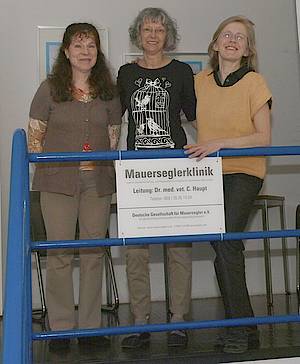
The beginnings as "Mobile Bird Aid"
Today's Swift Rescue Center began in 1994 as "Mobile Bird Aid" and as the dream of a rescue and rehabilitation centre of its own under veterinary direction. The model and the vision – once widely smiled at, today already within the realm of the possible! – was and still is the falcon clinic in the Emirate of Dubai (Abu Dhabi Falcon Hospital).
The founder of the Swift Rescue Center, Christiane Haupt, completed an internship in the summers of 1990 and 1991 at the officially recognised wildlife rescue and rehabilitation centre run by Ingeborg Polaschek near Gelnhausen in Hesse, where she above all learned the proper handling of wild bird patients of the most varied species. When Mrs Polaschek had to close her centre in 1992 for health reasons, Christiane Haupt's path was clear: she gave up her profession at the time as a freelance graphic designer and began to study veterinary medicine. Her goal: the competent treatment of birds, and of wild birds in particular!
Even during her first years at university, Christiane Haupt was constantly commuting between her home in Frankfurt and the university town of Gießen with any number of containers full of feathered foster children. These were the beginnings of "Mobile Bird Aid". During lectures, tits, sparrows, blackbirds, starlings and swifts were fed. When there were too many of them to keep hauling around, the anatomy professor's office became a refuge for the young birds.
Christiane Haupt increasingly specialised in Common Swifts. A few young swifts that had fallen from their nests, helpless, half starved. Then an injured adult swift. One look into those enigmatic dark eyes was enough – a passion was born. To help – but how? Word quickly spread that there was now someone here who looked after swifts. And so more and more birds arrived, from everywhere. While cramming for the final veterinary examinations: feeding, phone calls, feeding, treating injuries, feeding, X-rays, feeding – the state examination already took place with 32 Common Swifts brought along, waiting next door for their next feed!
The swift rehabilitation centre
In 1998, right after the final examinations were over, the number of swifts in care finally exceeded anything that could still be transported. The summer of 1998 became the first season of the swift rehabilitation centre at a fixed address. It was Christiane Haupt's private address, a small 35 sqm basement flat. Over the following four years it was to burst at the seams – year after year the small, entirely voluntary swift centre in Frankfurt am Main recorded more patients: whereas there had been 13 in 1994, 51 in 1995, 56 in 1996 and already 101 Common Swifts in 1997, a total of 163 Common Swifts were admitted in 1998. Finally, with 234 swift patients, the year 1999 burst the limits of what a single person could still cope with. Give up? Unthinkable. All that was, is and remains possible is to press ahead!
Deutsche Gesellschaft für Mauersegler e.V. – founding an association
Helpers turned up here and there, not infrequently recruited from the clientele that Christiane Haupt was looking after at the same time in her bird consultation hours at the renowned Frankfurt small animal clinic of Dr med. vet. Volker Hach. In terms of both staff and finances, the swift centre faced disaster day after day. Somehow things always carried on at the very last minute, not least thanks to the founding of the association "Deutsche Gesellschaft für Mauersegler e.V.", which became the body running the facility. Then, in 2002, came the end: in Christiane Haupt's basement flat the work of the swift centre could no longer be carried out under conditions worthy of either people or birds. The desperate search for new premises – and for the money to pay for them – began.
Officially recognised rescue and rehabilitation centre for Common Swifts
All efforts came to nothing. Once again, rescue at the last minute: the existing landlord made a 65 sqm flat in Frankfurt-Griesheim available at an acceptable rent. The centre's volunteers took care of makeshift renovation and fitting-out in record time, before the 2003 season began in new and larger premises. This is where the facility – by now known well beyond the region and even abroad, and officially recognised in 2005 as well – was housed until March 2012. There is a bird room, a training room, a combined office and operating room, a kitchen, a bathroom, a hallway and a cellar.
But as early as 2004/2005 it became clear that these rooms, too, were far too small for the influx of patients and the growing number of helpers. New, larger premises of at least 100–120 sqm were once again urgently needed for the institution, by now established as the Swift Rescue Center....
Into the future on 180 sqm: the Frankfurt Swift Rescue Center
In 2012 the time finally came. After a long and intensive search, the seemingly impossible came off: not far from the old centre, premises of 180 sqm became available that were affordable and, on top of everything else, even suitable for a clinic. Thanks to many willing hands they were renovated and furnished within a short time and in good time for the start of the season.
Since then the training room has offered enough space for flying. The considerably larger bird room allows additional feeding stations to be set up, so that new feeding volunteers can be trained even during the peak season. The kitchen offers enough room for freezers holding swift food and even for a small seating corner where people can catch their breath. Office and operating room are finally separate, and patients are no longer admitted "on the doorstep".
The area from which the feathered patients come has long extended far beyond the region, and for some years international cooperation has also been increasing, above all with other European bird protection and animal welfare organisations. A place at the Swift Rescue Center is especially sought after for patients that need their plumage restored (imping). In 2017 an Alpine Swift in Israel was able to be released back into the wild thanks to treatment. Usually between 700 and 800 patients are treated each year; in 2012 there were more than 800. In June 2018 the 12,000th patient was admitted; most patients are juvenile and adult Common Swifts, followed each year by a number of Alpine Swifts and Pallid Swifts.