The Common Swift Apus apus (LINNAEUS 1758) belongs, within the class of birds / Aves, to the swifts, which are grouped together as the order Apodiformes. Carl von Linné, to whom we owe the naming of species according to a binomial (binary) system, which begins with the 10th edition of his “Systema Naturae” in 1758 (BEZZEL and PRINZINGER, 1990), assigned the Common Swift to the swallows. There it appears under the name Hirundo apus (LINNAEUS 1758). The genus Apus was introduced by Scopoli in 1777 (GLUTZ and BAUER, 1980). Later the genus names Micropus and Cypselus were used as well, but did not become established. The scientific name Apus apus used here is identical to the one in GLUTZ and BAUER (1980) and in the most recent world list of birds by DICKINSON (2003).
WOLTERS (1975–1982) places the Apodiformes alongside the hummingbirds, Trochiliformes, as their closest relatives. SIBLEY and AHLQUIST (1990) confirm the assumption of a close relationship by means of DNA hybridisation, a method WOLTERS was not yet able to draw on, but they combine the two monophyletic sister groups swifts, Apodiformes, and hummingbirds, Trochiliformes, into a superorder Apodimorphae. Somewhat later, CHANTLER (in DEL HOYO et al., 1999) places swifts and hummingbirds in a single order Apodiformes with the two suborders Apodi and Trochili. There is agreement on the subdivision into families.
SIBLEY and AHLQUIST (1990) divide the order Apodiformes into the two families Apodidae, the true swifts, with about 94 species recognised today (DICKINSON 2003), and Hemiprocnidae, the treeswifts, with 4 species. The taxonomy at the level of genera and species has not yet been completely and uncontroversially resolved. Especially in the large genus Collocalia, the swiftlets, the delimitation of species is in part still unclear. The same applies to some African species of the genus Apus.
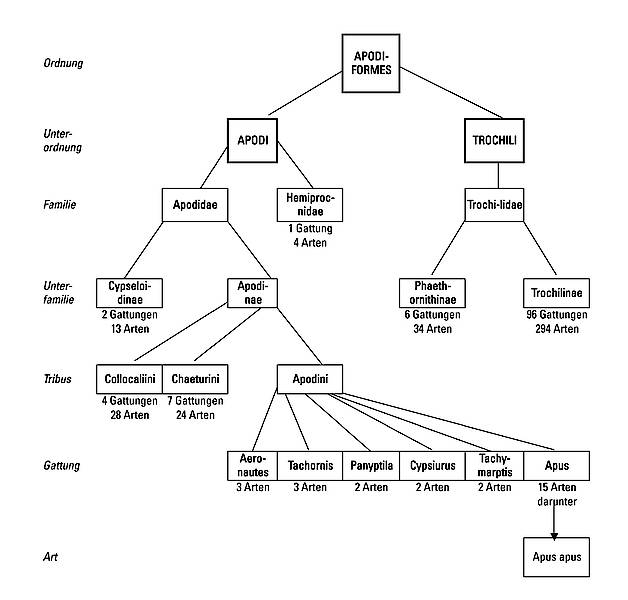
Cladogram of the order Apodiformes according to Chantler (in Del Hoyo et al., 1999)
New insights into groups that have so far hardly been studied are to be expected in the near future, above all from molecular genetic research. Quite generally, the taxonomy at the level of species and subspecies has become highly fluid in ornithology, in connection with differing species concepts and especially in view of the superspecies concept, so that alternative proposals are to be expected. In particular, the numbers of species per genus should be regarded merely as a current proposal. In some regions (tropical Asia, Central Africa), the discovery of previously unknown species is also not unlikely.
Swifts arose in tropical climates and then, with the break-up of the Gondwana continent, developed into Old World and New World subfamilies, with the Cypseloidinae in South and North America and the Apodinae in Africa, Europe and Asia. The genus Apus is distributed throughout the Old World, but most species occur in Africa; 6 species are even endemic to sub-Saharan Africa. Today swifts are cosmopolitan, apart from the very high latitudes. Two factors have made this possible: the extreme adaptation of some species to human habitation through their choice of nest sites in urban settlements, and their evolution into long-distance migrants. Being extremely altricial young with the ability to enter hunger torpor, the nestlings can also be raised successfully in the climates of higher latitudes with their unreliable summer weather.