Der Mauersegler Apus apus (LINNAEUS 1758) zählt innerhalb der Klasse Vögel / Aves zu den Seglern, die als Ordnung Apodiformes zusammengefasst werden. Carl von Linné, auf den die Benennung der Arten nach einem binominalen (binären) System zurückgeht, das mit der 10. Auflage seiner „Systema Naturae“ 1758 beginnt (BEZZEL und PRINZINGER, 1990), rechnete den Mauersegler zu den Schwalben. Er findet sich dort unter der Bezeichnung Hirundo apus (LINNAEUS 1758). Die Gattung Apus führte Scopoli 1777 ein (GLUTZ und BAUER, 1980). Später wurden auch die Gattungsnamen Micropus und Cypselus verwendet, setzten sich aber nicht durch. Der hier verwendete wissenschaftliche Name Apus apus ist identisch mit dem bei GLUTZ und BAUER (1980) und in der neuesten Weltliste der Vögel von DICKINSON (2003).
WOLTERS (1975–1982) stellt die Apodiformes als nächstverwandt neben die Kolibris, Trochiliformes. SIBLEY und AHLQUIST (1990) bestätigen die Annahme einer näheren Verwandtschaft mit der DNA-Hybridisation, auf die WOLTERS noch nicht zurückgreifen konnte, fassen aber die beiden jeweils monophyletischen Schwestergruppen Segler, Apodiformes und Kolibris, Trochiliformes zu einer Überordnung (Superorder) Apodimorphae zusammen. Etwas später plaziert CHANTLER (in DEL HOYO et al., 1999) Segler und Kolibris in eine Ordnung Apodiformes mit den beiden Unterordnungen Apodi und Trochili. Bei der Gliederung in Familien besteht Übereinstimmung.
Die Ordnung Apodiformes gliedern SIBLEY und AHLQUIST (1990) in die beiden Familien Apodidae, eigentliche Segler, mit etwa 94 heute anerkannten Arten (DICKINSON 2003) und Hemiprocnidae, Baumsegler, mit 4 Arten. Die Taxonomie auf der Ebene von Gattungen und Spezies ist derzeit noch nicht restlos und unumstritten geklärt. Insbesondere in der großen Gattung Collocalia, Salanganen, sind die Speziesabgrenzungen teilweise noch unklar. Ähnliches gilt auch für einige afrikanische Arten der Gattung Apus.
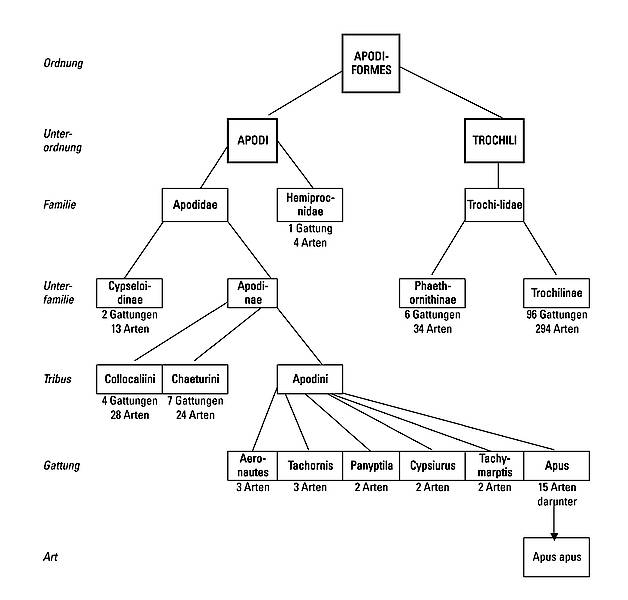
Vor allem von molekulargenetischen Untersuchungen sind in nächster Zukunft neue Einsichten bei bisher noch kaum untersuchten Gruppen zu erwarten. Ganz allgemein ist in der Ornithologie im Zusammenhang mit unterschiedlichen Artkonzepten und vor allem unter dem Aspekt des Superspezieskonzeptes die Taxonomie auf der Ebene von Spezies und Subspezies sehr in Bewegung geraten, so dass mit alternativen Vorschlägen zu rechnen ist. Insbesondere sind Artenzahlen pro Gattung nur als ein aktueller Vorschlag zu werten. In manchen Gebieten (tropisches Asien, Zentralafrika) sind auch Neuentdeckungen von bisher unbekannten Arten nicht unwahrscheinlich.
Segler sind in tropischen Klimaten entstanden und haben sich dann mit dem Auseinanderbrechen des Gondwanakontinents zu altweltlichen und neuweltlichen Unterfamilien mit den Cypseloidinae in Süd- und Nordamerika und den Apodinae in Afrika, Europa und Asien entwickelt. Die Gattung Apus ist über die ganze Alte Welt verbreitet, die meisten Arten kommen aber in Afrika vor, 6 Arten sind für das subsaharische Afrika sogar endemisch. Heute sind Segler bis auf die sehr hohen Breiten kosmopolitisch. Zwei Faktoren haben dies ermöglicht: Die extreme Kulturfolge einiger Arten durch die Nistplatzwahl in urbanen Siedlungen und die Evolution zum Langstreckenzieher. Die Jungen als extreme Nesthocker mit der Fähigkeit zu Hungertorpor können auch in Klimaten höherer Breiten mit unsicherem Sommerwetter erfolgreich aufgezogen werden.