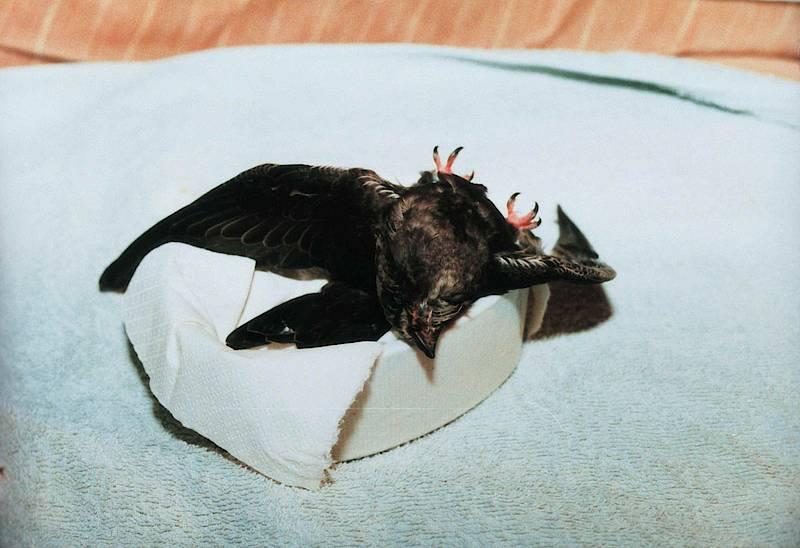
Krampfanfall durch Vitamin B-Mangel. © C. Haupt
Eine Vielzahl von Abstürzen oder von Anflügen gegen Stromleitungen, Autos, Fensterscheiben oder dergleichen endet sofort tödlich, so dass keine Hilfe mehr möglich ist. Überlebt aber der Vogel den Aufprall zunächst, ist rasches Handeln nötig: So schnell wie möglich muss vom Tierarzt eine Schockbehandlung vorgenommen werden.
Machen Sie keinesfalls Tränk- oder Fütterungsversuche!
Krampfgeschehen und Störungen des zentralen Nervensystemes können sehr unterschiedliche Ursachen haben. Häufig treten sie in Folge eines Unfalles auf, und manchmal kommt ein betroffener Segler mit einer Gehirnerschütterung davon, ist lediglich matt und benommen und erholt sich nach einigen Tagen Ruhe und Wärme. Treten jedoch schwerwiegendere Symptome auf, wie z.B. Krampfanfälle, Kreiselbewegungen, Überschlagen, stereotype Kopfbewegungen, ist die Prognose zweifelhaft. Solche Patienten gehören so schnell wie möglich in die Hand eines vogelkundigen Tierarztes!
Krampfgeschehen sind auch bei handaufgezogenen Mauerseglern zu beobachten, die artgerecht mit Insekten gefüttert werden. Zugrunde liegt ein Mangel an Vitaminen des B-Komplexes.
Der Symptomkomplex des Vit.B-Mangels kann sehr plötzlich auftreten, rasant fortschreiten und unbehandelt schlimmstenfalls zum Tode führen. Der Verlauf ist umso dramatischer, je jünger der Mauersegler ist: Ein Nestling im Alter von wenigen Tagen kann binnen einer Stunde daran sterben.
Die Symptome beginnen unmerklich mit Essunlust, starrem Blick und zwanghaften Kopfbewegungen und steigern sich bis zum Kopf-in-den-Nacken-werfen, zu unkontrollierten Krämpfen und Kreisbewegungen. Bei Altvögeln wurden auch markerschütternde Schreie, schmerzhaftes Festkrallen und wildes Herumwerfen beobachtet. Solche Anfälle können vom Tierarzt durch eine Injektion mit Vitamin-B-Komplex umgehend behoben werden. Meist sind die Vögel eine halbe Stunde danach wieder unauffällig.
Schneller betroffen sind Mauersegler, die mit Mehlwürmern oder mit Grillen minderer Qualität gefüttert werden sowie solche, die über die normale Aufzuchtzeit hinaus in Menschenhand verbleiben müssen, z.B. "Federschieber". Doch hat im Laufe der letzten Jahre aus bisher ungeklärten Gründen die Anfälligkeit in Menschenhand befindlicher Mauersegler generell so zugenommen, dass es sich empfiehlt, den Vögeln vom Tierarzt alle Tage prophylaktisch eine subkutane Injektion mit Vit. B–Komplex verabreichen zu lassen.
Eine Verabreichung von Vitamin B in den Schnabel hat sich beim Mauersegler als weitgehend unwirksam erwiesen. Auch die vorbeugende Verabreichung mit dem Futter scheint Mangelsymptome nicht immer verhindern zu können. Der Symptomkomplex des Vit. B–Mangels ist auch bei Schwalben und anderen insektenessenden Singvögeln bekannt, die in Menschenhand gepflegt werden.